Charger images
Les formats d'image autorisés sont de type jpeg, png ou gif
La taille maximale du fichier doit être de 20MB
.jpg)
.jpg)
.jpg)
With a wide variety of habitats and common bird species on offer, Whitlingham is easily accessible and offers a great escape for city-based birders.
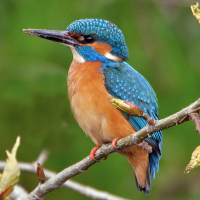
Whitlingham Country Park is owned and managed by the Whitlingham Charitable Trust, and consists of two lakes, Great Broad and Little Broad (both created by former gravel extraction) with the River Yare running parallel alongside. There is also a stand of mixed deciduous woodland and a small area of marshland on the south-east side of the park. The site has a Visitor Centre with a café and toilet facilities available. The paths round the park are well maintained, and suitable for birders of all abilities, although the paths can get muddy in some spots in winter. There are also bikes for hire at the Visitor Centre, which could make your travel around the site more exciting. In all seasons, the site hosts wetland birds including Martin-pêcheur d'Europe , Grèbe huppé , Grand Cormoran, Cygne tuberculé and Ouette d'Égypte. A search around the woodland may reveal Pic épeiche, Grimpereau des bois, Roitelet huppé and a variety of common garden birds. Listen out for Bouscarle de Cetti calling loudly around the lake margins too.
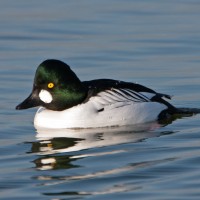
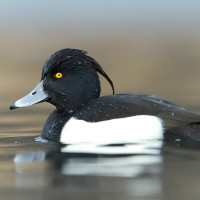
Winter is considered by birders as the best time to visit. Large flocks of diving duck can be seen on Great Broad (the largest lake) including Fuligule morillon accompanied by smaller numbers of Fuligule milouin and Garrot à oeil d'or. In colder periods, lucky birders may find Harle bièvre, Harle piette or Fuligule milouinan, all of which are seen at Whitlingham most winters. A secretive Butor étoilé may also be hiding in the reeds on the northern edge of the lake. Dabbling ducks prefer Little Broad, where Canard chipeau, Canard souchet and Sarcelle d'hiver are usually present. The alder trees lining the lakes are a fantastic place to search for wintering flocks of Tarin des aulnes and Sizerin cabaret.
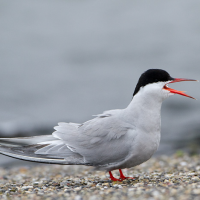
Spring sees warblers returning to the park, and the woodland fills with the sound of Pouillot véloce, Fauvette à tête noire and Fauvette des jardins. The lake margins may be visited by returning waders including Chevalier guignette and Huîtrier pie, while Sterne pierregarin and large numbers of hirundines including Hirondelle de rivage and Hirondelle rustique may be feeding over the water. Following heavy rainfall in April, scarcer species such as Sterne arctique, Mouette pygmée and Macreuse noire may also be found on the lakes, while Guifette noire are annual visitors for brief periods in May. Listen out for calls of Coucou gris across the park.
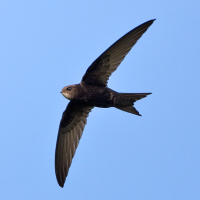
Summer and autumn can be a quieter time for birding at Whitlingham, but expect large numbers of Oie cendrée on Great Broad in July and August, and keep your eyes to the skies for Faucon hobereau and Martinet noir feeding on the flying insects over the lakes. Occasionally, Busard des roseaux will drift over the park from other areas of the Yare Valley, and Canard mandarin may also be encountered. The reedbeds may be filled with the chatter of Rousserolle effarvatte. In September and October, keep an eye out for thrushes including Grive mauvis and Grive litorne, as well as returning wildfowl.
Whitlingham Country Park is only two miles from Norwich city centre, and can be reached easily by car, bike or on foot from any bus stop near Trowse. There are large pay and display car parks near the visitor centre, as well as racks to lock up your bike safely if cycling to the site. More details can be found on the Whitlingham Country Park website.
Taking the circular walk around Great Broad is recommended at all times of the year (especially winter), while a walk around the woodland may be warrented in spring. A scope is not necerssary, but may help when scanning though flocks of diving ducks or gulls in the winter.
Whitlingham Country Park is popular with families, dog walkers, fishermen and watersports enthusiasts. Therefore, the park can be very busy, especially during weekends or on warm sunny days. For birders, it is recommended that they visit in the mornings and evenings to avoid the most likely times for disturbance by other activites.
 ) Insérez les noms d'oiseau dans votre langue. Ils seront automatiquement traduits pour les autres usagers !
Votre feedback sera transmis à l’auteur.rice de cette zone et à l’équipe éditoriale de Birdingplaces, qui l’utiliseront pour améliorer la qualité des informations. (Vous souhaitez publier un commentaire visible en bas de page ? Fermez cette fenêtre et choisissez l’Option 1 : « Publier un commentaire, un conseil ou une observation ».)
Veuillez fournir des suggestions d'améliorations ou d'ajouts au texte de ce site ornithologique.
Veuillez fournir vos suggestions d'améliorations ou d'ajouts à la carte.
Veuillez fournir des suggestions d'améliorations ou d'ajouts à la liste des oiseaux.
Cliquez sur l'icône de l'oiseau () Insérez les noms d'oiseau dans votre langue. Ils seront automatiquement traduits pour les autres usagers !